
Arc Fault and Ground Fault Circuit Protection
Description of product:
AFCI and GFCI – Circuit Breakers
The NEC code typically changes every 3 years and not all states, municipalities adopt the current NEC code requirements. Guests and contractors should check with their local municipality to determine which NEC year they should be adhering too. Below is a listing of where AFCI and GFCI breakers should be utilized.
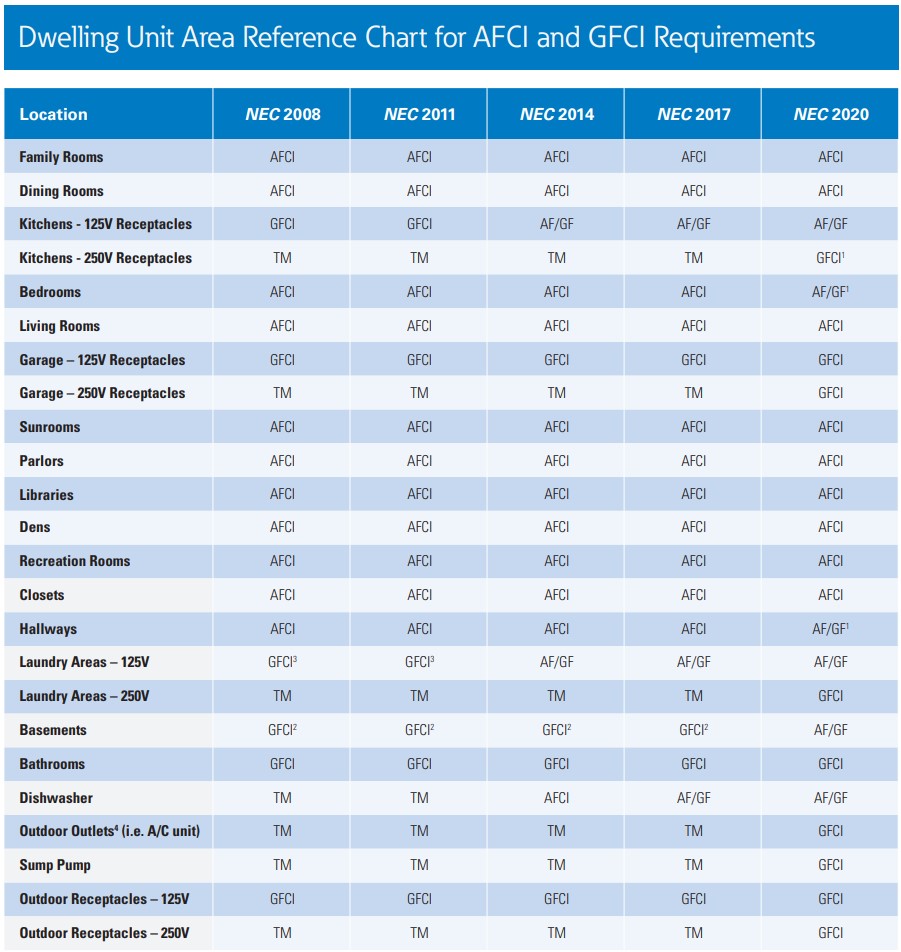
TM = Thermal-Magnetic Breaker
AF / AFCI = Arc-Fault Circuit-Interrupter
GF / GFCI = Ground-Fault Circuit-Interrupter
1: GFCI protection required if receptacle outlet is within 6ft of edge of sink (i.e. bedroom bathroom; hallway bathroom, etc.)
2: Unfinished basements
3: Where the receptacle is installed within 6ft of the outside edge of the sink
4: Example of outdoor outlet loads (150V to ground or less; 50A or less; single-phase) are Air Conditioner unit, Septic Aerator, etc.
Refer to the appropriate section of the NEC for further details on the specific requirements.
Description of product:
Arc-Fault Circuit Protection – Circuit Breakers and Receptacles
Q. What are the AFCI requirements for new construction?
A. As defined by the 2014 NEC, there are several ways to meet this requirement:
- Use a Combination AFCI Circuit Breaker – this provides both parallel & series AFCI protection throughout the entire circuit.
- Use a “Branch” style AFCI Circuit Breaker (commonly required in AFCI circuits prior to the 2008 NEC – “branch” style provides parallel arc protection only), in conjunction with an AFCI receptacle located at the first receptacle outlet of the existing circuit. This method provides Combination AFCI protection throughout the entire circuit.
- Use a standard circuit breaker with an AFCI receptacle located at the first receptacle outlet of a circuit…the wire between the circuit breaker and the AFCI receptacle must be enclosed in metal conduit or armored cable (the circuit must be enclosed in metal), from the loadcenter to the junction box containing the first AFCI receptacle. This method contains an occurring arc between the loadcenter and the first AFCI receptacle. The AFCI receptacle then provides combination AFCI protection for the remaining portion of the circuit.
- Use a standard circuit breaker with an AFCI receptacle located at the first receptacle outlet of a circuit…the wire between the circuit breaker and the AFCI receptacle must be enclosed in a listed metal OR nonmetallic conduit or tubing encased in not less than 2 inches of concrete, for the portion of the circuit between the loadcenter and the junction box containing the first AFCI receptacle. This method contains an occurring arc between the loadcenter and the first AFCI receptacle. The AFCI receptacle then provides combination AFCI protection for the remaining portion of the circuit.
2. Q. What are the AFCI requirements for use in Renovation?
A. As defined by the 2014 NEC, for any AFCI required circuits where branch circuit wiring is modified, replaced, or extended, the circuit shall be protected by:
- Use of a Combination AFCI Circuit Breaker,
OR
- Use a standard circuit breaker with an AFCI receptacle located at the first receptacle outlet of the existing branch circuit.
- NOTE: Any renovation that causes the replacement of an existing loadcenter with a new loadcenter, shall be considered
- New Construction, and new construction AFCI requirements shall be used.
3. Q. What does a GFCI Breaker do?
A. Eaton’s GFCI Breakers provide superior safety and ensure electric shock protection in areas where electricity may come into contact with water such as kitchen countertops, bathrooms, swimming pools, hot tubs and out-door receptacles. GFCI breakers immediately break the circuit when electrical current leakage is being detected, reducing the risk of shock and electrocution.
4. Q. Is the 2014 NEC followed in all applications?
A: Guests should always check with their local code enforcement body, to understand if all or part of the 2014 NEC code is followed locally.
List examples of projects that would require this product:
For use as replacement breaker, or receptacle in an existing structure or loadcenter
For ‘add-on’ when any new circuit is being installed using an existing loadcenter, or structure.
For new construction, when a new loadcenter is being installed, and AFCI protection is required for circuits in the dwelling.
| List the top 3 features this product offers: | List the benefits the Guest will gain from each feature: | |
|---|---|---|
| 1 | Arc-Fault circuit breakers & receptacles provide protection from fires when caused by arcing faults on a circuit. | Reduces the risk of electrical fires started by arcing faults on a circuit. |
| 2 | Parallel & Series arc-fault detection and protection for installed wiring AND connected cords & equipment. | Arc-Fault detection on the entire circuit, including wire out to the receptacle or switch, or any cord & equipment plugged into the receptacle. |
| 3 | AFCI breaker provides the additional benefit of thermal & magnetic overcurrent protection, just like a standard circuit breaker. | Provides over-current & short circuit protection for the circuit. Protects the wiring on the circuit, by preventing the wire from over-heating. |
Ground Fault- A ground fault is the unintentional electrical path between a power source and a grounded surface. The leakage current usually occurs when an electrical appliance is damaged or the electrical parts are wet, causing the current to flow outside of the circuit conductors.
Arc Fault- An arc-fault occurs when loose or corroded connections make intermittent contact and causes sparking or arcing between the connections. This translates into heat, which will break down the insulation of the wire and can be the trigger for an electrical fire.
Short Circuit- Occurs when part of a wire carrying current touches another wire or part of the circuit and gives the electricity a path of less resistance. Example: Animals like mice, rats and squirrels sometime chew on wires. This can cause neutral and live wires to cross and result in a short.
GFCI- Help prevent burns, electric shocks, and electrocution. A GFCI has sensors that measure the current going in and out. Normally, the current is balanced. However, if the current is out of balance, something is wrong. The electric current has made contact with a human or somewhere else it should not be. The GFCI senses this and instantly shuts down the circuit, stopping the flow of electricity.
AFCI- Help prevent electric fires. Electricity can leak out of damaged or decaying wires and start a fire. These fires spread quickly in the wiring behind walls. Electric fires cause more damage than some other types of fire and are twice as deadly. AFCIs sense electricity is leaking from the electric system and shut electricity off before overheating happens.
GFCIs prevent shocks, and AFCIs prevent fires.
AFCI BREAKER- Detect arcing within the electrical system and stop the flow of electricity before arcing develops into an electrical fire. The AFCI is a circuit breaker with an integrated processor that recognizes the unique current/voltage signatures of arcing. AFCI’s detect arcing whether in a circuit, extension cord or appliance.
Branch Feeder AFCI- Provide conventional thermal and magnetic overcurrent protection. It also provides high current or parallel arcing fault (Nail thru a wire insulation) detection and fire mitigation for installed wiring and connected cords. Yellow label or Test Button
Combo AFCI- Provide conventional thermal and magnetic overcurrent protection. It also provides high current or parallel arcing fault detection and fire mitigation for installed wiring and connected cords. The combination AFCI has the added benefit of enhanced detection of persistent low current or series arcing faults (frayed cord) which mitigate fire hazards in cords connected to outlets. Green Label or Test Button
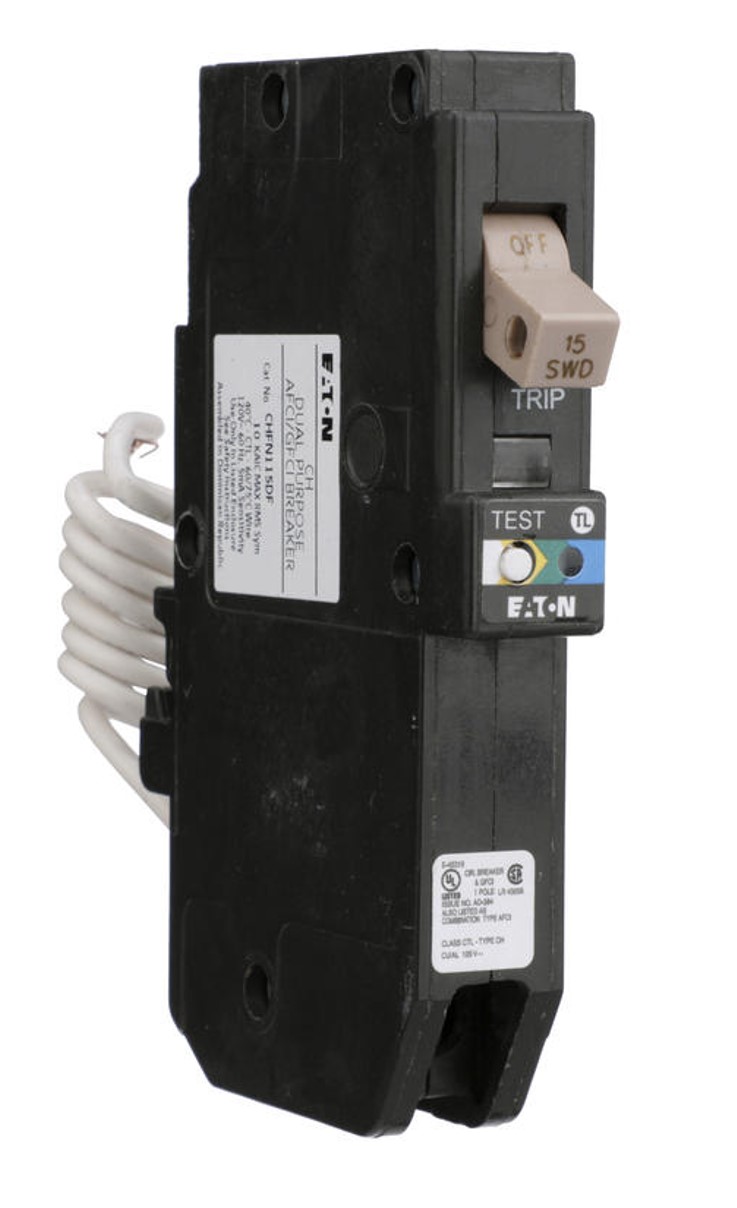
Dual Purpose AFCI/GFCI- Combines Arc Fault and Ground Fault protection in one, detects parallel and series arcs and ground faults. Blue Label or Test Button
Arc Fault and Ground Fault Circuit Protection Quiz
Quiz Summary
0 of 9 Questions completed
Questions:
Information
You have already completed the quiz before. Hence you can not start it again.
Quiz is loading...
You must sign in or sign up to start the quiz.
You must first complete the following:
Results
Results
0 of 9 Questions answered correctly
Your time:
Time has elapsed
You have reached 0 of 0 point(s), (0)
Earned Point(s): 0 of 0, (0)
0 Essay(s) Pending (Possible Point(s): 0)
Categories
- Not categorized 0%
-
Note: If you scored 75% or higher, you passed! If you scored lower than 75%, just remember you only get 3 attempts total to take the quiz. (E.g. If you took the quiz once, you only get 2 more retakes).
Back to My Account
- 1
- 2
- 3
- 4
- 5
- 6
- 7
- 8
- 9
- Current
- Review
- Answered
- Correct
- Incorrect
-
Question 1 of 9
1. Question
Is there a combination Arc Fault and Ground Fault or do I have to use one Arc and one Ground Fault?
-
Question 2 of 9
2. Question
Can I just replace my existing Breaker in my load center with an Arc or Ground Fault Breaker?
-
Question 3 of 9
3. Question
Where would a GFCI circuit breaker be used?
-
Question 4 of 9
4. Question
What is the main purpose of a GFCI breaker?
-
Question 5 of 9
5. Question
What is the main purpose of ARC Fault protection?
-
Question 6 of 9
6. Question
According to 2020 NEC code, which rooms in house need to be protected by arc fault or GFCI breakers on new construction?
-
Question 7 of 9
7. Question
GFCI protection required if receptacle outlet is within ______ of edge of sink?
-
Question 8 of 9
8. Question
What is the difference between AFCI and GFCI?
-
Question 9 of 9
9. Question
Does a GFCI protect against Arc Faults?