
Electrical Terms and Definitions
Electrical Definitions
(* Indicates NEC 2014 Article 100 Definitions)
Arc – Electrons crossing a small gap between two conductors. An arc is likely occurring when a crackling noise is heard inside a device.
Arc Fault – An abnormal condition where an arc occurs (corroded or loose connection).
Arc fault circuit interrupter (AFCI) – A circuit breaker that will also trip when it detects an abnormal arc.
Arc flash – Happens when anything connected to a line phase (like a line wire) in the process of touching anything that is connected to a different line phase, neutral or ground. The arc flash actually starts before contact is made when the current jumps a tiny gap.
Alternating current (AC) – Current that travels in both directions. Residential and commercial power use AC.
Amp – (Short for amperes) Electrical measurement of the quantity of the flow of electrons.
Ampacity* – The maximum current, in amperes, that a conductor can carry continuously under the conditions of use without exceeding its temperature rating.
AWG – American wire gauge, a standard wire gauge system to correlate wire diameters to gauge numbers.
Circuit – Circuit breaker(s), conductors (wires), and electrical outlets. Conductors in a circuit contain line, neutral, and ground conductor(s). Older systems may not contain ground conductors.
Circuit breaker* – A device designed to open and close a circuit by nonautomatic means and to open the circuit automatically on a predetermined overcurrent without damage to itself when properly applied within its rating. (Example: The circuit breaker will trip during a short circuit, ground fault, and
overload condition.)
Conductor – Materials that allow the flow of electrons easily, including silver, copper, gold, and aluminum. Electrical wires are mostly made of copper, some are made of aluminum.
Continuity – A circuit has continuity when there is a continuous path for electricity to flow through the circuit (free from open circuit conditions). A multimeter, continuity tester, and certain solenoid testers can measure continuity.
Continuous load – A load where the maximum current is expected to continue for three hours or more.
Current – The flow of electrons through a conductor, the quantity is measured in amps (A).
Current flow direction – It is not known for sure what direction currents flow. The conventional theory of current flow is from positive (+) to negative (-).
Dedicated circuit – A circuit that has only one outlet and is used for one load that has a high current rating.
Device* – A unit of an electrical system that carries or controls (but does not use) electric energy as its principal function. (Example: outlet or switch)
Direct current (DC) – Current that only goes in one direction. Battery supplied power is DC.
Electrical load – Electrical equipment (appliances, electronics, light bulbs, etc.) that use electrical energy.
Electrical system – The electrical components used to supply electricity to a structure. Components include panels, wiring, outlets, fixtures, etc.
Fault – (Ground fault) This happens when an ungrounded conductor (line wire) comes in contact with anything that is grounded (i.e. motor winding touching case, or line wire of appliance touching the metal frame.)
Gauge – See AWG.
Ground – An electrical reference point that connects to the earth. Ground connects to neutral at a single neutral point on an electrical system measuring zero volts (0 volts).
Ground conductor – Also known as grounding conductor, is connected to earth ground, and does not carry current during normal conditions. It connects to neutral at the grounding point of an electrical system. A grounding conductor will carry current during a short circuit or ground fault condition.
Ground fault – This happens when an ungrounded conductor (line wire) comes in contact with anything that is grounded, (i.e. motor winding touching case, or line wire of appliance touching the metal frame.)
Ground fault interrupter (GFCI) – An outlet or circuit breaker that will trip when current from the line does not return through the neutral (ground fault).
Ground screw – A green screw specifically used to connect a ground wire to a metal electrical box.
Hot conductor – The ungrounded conductor. This is the conductor that has voltage. In a household, the wire color is
black or red.
Impedance – Electrical measurement of the opposition of the flow of electrons in a conductor with the effects of capacitance and induction as measured in ohms.
Insulator – Materials that resist the flow of electrons, including plastic, fiberglass, and rubber.
Kilowatt – 1,000 watts
Kilowatt Hour (kWh) – 1,000 watts for 1 hour.
Line – (Electrical line) source of electrical power (electrical panel, circuit breaker).
Line Side – The wire connection terminals of a GFCI, occupancy sensor, photocell, etc. that connect to a circuit breaker through a wire.
Load – (Electrical load) Electrical equipment (appliances, electronics, light fixtures, etc.) that use electrical energy.
Load Side – The wire connection terminals of a GFCI, occupancy sensor, photocell, etc. that connect to a load.
NEC – National Electrical Code.
Neutral Conductor – Is a conductor that carries current in normal conditions. It is connected to ground at the neutral point in the system. The voltage on a neutral conductor is 0 volts (or very close to 0 volts under load conditions).
Warning: A neutral conductor can carry voltage when opened on a live circuit.
Neutral point – Is where ground and neutral are connected in an electrical system.
NM Cable – NM is a type of cable that contains insulated conductors enclosed within an overall nonmetallic jacket. It is commonly known as “Romex®”, which is the brand that is most widely used.
Nominal voltage – 120 volts & 240 volts are the standards to designate a voltage class for residential buildings. All other voltages are high or low voltage ratings of light bulbs, appliances, electronics etc.
Higher voltage ratings of 125, 130, 230, and 250 volts are for switches, outlets, bulbs, and certain loads. These ratings indicate the upper limit of voltage for a device or load to operate properly under normal conditions.
Lower voltage ratings of 110, 115, and 220 volts are for loads (appliances, motors, etc). These ratings indicate the lower limit of voltage for proper operation under normal conditions.
Ohms – Electrical measurement of the opposition of the flow of electrons in a conductor.
Open circuit – An opening in a conductor path that prevents the normal flow of electricity.
Outlet – The points at which the electrical system are accessed. (receptacle outlet, lighting outlet, etc.)
Overcurrent* – Any current in excess of the rated current of equipment or the ampacity of a conductor. It may result from overload, short circuit, or ground fault.
Overload* – Operation of equipment in excess of normal, full-load rating, or of a conductor in excess of rated ampacity that, when it persists for a sufficient length f time, would cause damage or dangerous overheating. A fault, such as a short circuit or ground fault, is not an overload.
Photocell – A switch that will close when darkness falls, usually turning on lights at night.
Potential difference – The difference between positive and negative charges; these differences result in voltage.
Power – Electrical measurement of The total electrical energy including voltage (force) times current (quantity). Power is measured in watts (W).
Qualified person* – One who has skills and knowledge related to the construction and operation of the electrical equipment and installations and has received safety training to recognize and avoid the hazards involved.
Resistance – The opposition of the flow of electrons in a conductor as measured in ohms.
Short circuit – An abnormal condition where a line conductor comes in contact with neutral, ground, or another line conductor of a different phase.
Volts – Electrical measurement of force or potential difference.
Voltage – The electrical force or potential difference measured in volts (V).
Voltage (Nominal) – See Nominal Voltage.
Voltage Drop – The drop in voltage from the voltage source to a load caused by resistance in a circuit path (mostly wires).
Volt-amps (VA) is an electrical measurement of power (volt-amps = volts * amps power factor). Volt-amps is known as apparent power.
Watts – Electrical measurement of power (volts x amps). Watts is known as apparent power.
Wire Makeup – Two or more wires connected together with wire nuts inside an electrical box.
Electrical Circuits
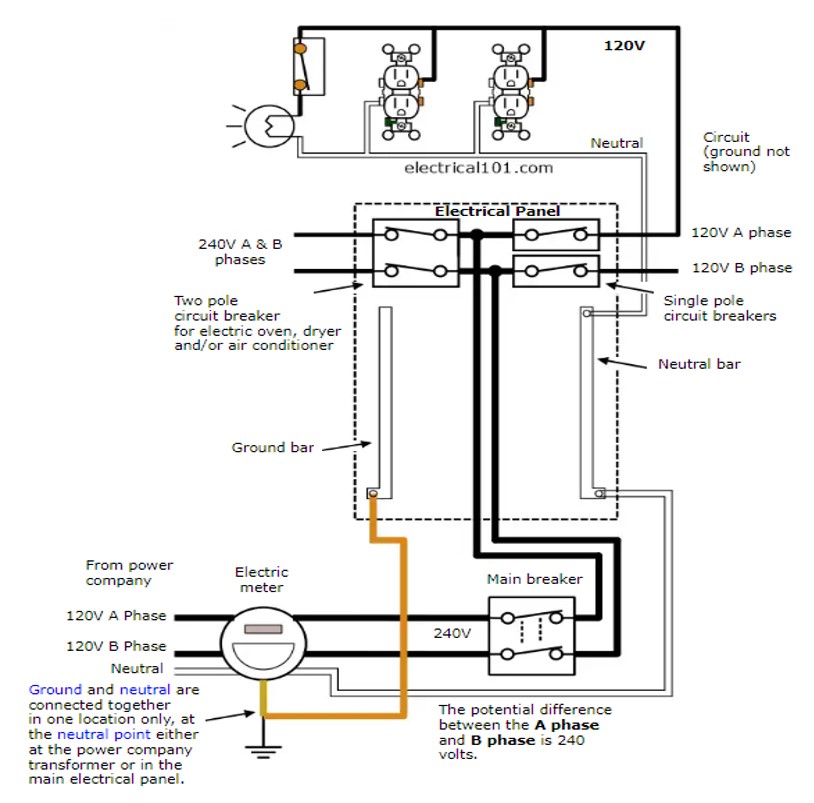
Household Circuits Diagram
These diagrams show a typical circuit path from the power company through the main electrical panel
and to the outlets (light sockets, switches, and outlets).
Current Rating of a Circuit
Current rating of a circuit is defined by the lowest current rating of wires and circuit breakers on that circuit.
Wire Gauge and Current Rating
NM wire gauges range from 14 AWG to 6 AWG. The following show the most common wire gauges:
• 14 AWG for lighting circuits and rated for 15 amps.
• 12 AWG for outlets and rated for 20 amps.
• 10 AWG for dryers and electric ranges, and rated for 30 amps.
• 8 AWG for air conditioning and heat pumps and rated for 40 amps.
The chart to the right shows the proper circuit breaker to be used for the wire gauge in a circuit.
Wire Gauge Breaker and Rating
| Wire Gauge | Approximate Wire Diameter Inch / Millimeter | Breaker Rating |
|---|---|---|
| 14 | 0.111 / 2.819 | 15 AMP |
| 12 | 0.130 / 3.302 | 20 AMP |
| 10 | 0.164 / 4.166 | 30 AMP |
| 8 | 0.216 / 5/486 | 40 AMP |
15 Amp Circuit Rating
When a circuit is rated for 15 amps, the wires and circuit breakers must be rated for at least 15 amps. The circuit is rated for the lowest current rating of wire or circuit breaker. For example, if the wire is rated for 15 amps, the circuit should not have a 20 amp breaker even if the breaker trips frequently.
20 Amp Circuit Rating
When a circuit is rated for 20 amps, the wires and circuit breakers must be rated for at least 20 amps. It is important that a 20 amp (or higher) circuit breaker NOT be used on a circuit with a wire rated for 15 amps or less.
Electrical Terms and Definitions Quiz
Quiz Summary
0 of 3 Questions completed
Questions:
Information
You have already completed the quiz before. Hence you can not start it again.
Quiz is loading...
You must sign in or sign up to start the quiz.
You must first complete the following:
Results
Results
0 of 3 Questions answered correctly
Your time:
Time has elapsed
You have reached 0 of 0 point(s), (0)
Earned Point(s): 0 of 0, (0)
0 Essay(s) Pending (Possible Point(s): 0)
Categories
- Not categorized 0%
-
Note: If you scored 75% or higher, you passed! If you scored lower than 75%, just remember you only get 3 attempts total to take the quiz. (E.g. If you took the quiz once, you only get 2 more retakes).
Back to My Account
- 1
- 2
- 3
- Current
- Review
- Answered
- Correct
- Incorrect
-
Question 1 of 3
1. Question
What gauge wire is used for 20-amp circuits?
-
Question 2 of 3
2. Question
Can you use wire rated for 15-amp circuit for a 20-amp breaker?
-
Question 3 of 3
3. Question
What is the difference between amps and volts?